
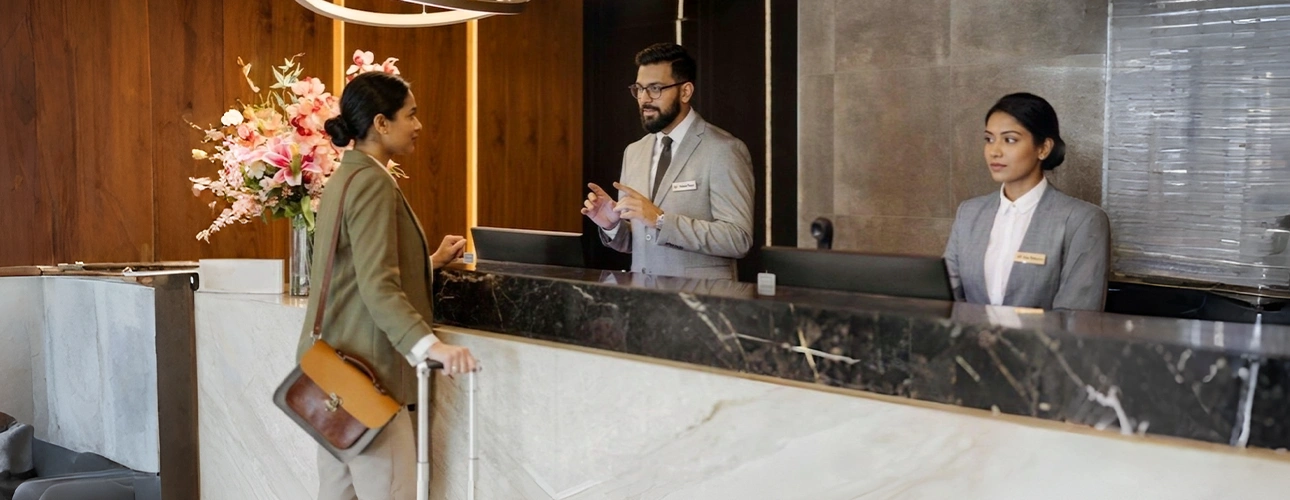
Corporate hotel negotiations are no longer about simply asking a hotel for its lowest room rate. For Indian travel managers, the smarter approach is to analyse booking volumes, preferred locations, traveller requirements, cancellation patterns, inclusions, payment terms, and service expectations before negotiating. The best strategy is to compare the total value of a hotel programme rather than focusing only on the headline room price. This is where SKIL Travel can help businesses structure negotiations, compare properties, manage corporate rates, and create accommodation programmes that balance cost, convenience, compliance, and traveller experience.
Hotel accommodation is one of the largest components of managed business travel expenditure. According to the Global Business Travel Association, business travellers worldwide spend approximately $461 billion annually on lodging, making accommodation a major corporate travel spending category.
For Indian organisations with employees travelling regularly between Mumbai, Delhi, Bengaluru, Hyderabad, Chennai, Pune, Kolkata and other business centres, even a modest reduction in the average nightly cost can create meaningful annual savings.
Public hotel prices fluctuate according to demand, seasonality, events and inventory. A negotiated corporate programme can provide greater predictability while potentially adding benefits that are difficult to obtain through ordinary online bookings.
The Global Business Travel Association's 2026 research shows that hotel sourcing is becoming more sophisticated, with organisations increasingly combining fixed rates and dynamic discounts rather than depending on one pricing model.
The objective should not simply be "get the cheapest room". It should be "secure the best commercial value for the company's actual travel pattern".
For example, a hotel offering a slightly higher room rate with complimentary breakfast, airport transfers and flexible cancellation may deliver greater total value than a cheaper room with several additional charges.
A useful industry perspective
Suzanne Neufang, CEO of the Global Business Travel Association, notes that travel managers are increasingly balancing costs with risk management and traveller experience while using technology to make programmes more efficient.
That principle is particularly relevant to Indian businesses managing frequent domestic travel.
Negotiation becomes significantly stronger when the buyer understands its own demand. A hotel is more likely to provide attractive commercial terms when a company can demonstrate realistic and measurable business potential.
A Request for Proposal, or RFP, should give hotels enough information to make a commercially realistic offer. GBTA describes the hotel RFP as a central part of a well-managed corporate hotel programme because it helps buyers secure competitive rates, inventory and traveller satisfaction.
A useful RFP should cover:
Not necessarily. A company with significant travel volumes may benefit from a structured portfolio approach involving preferred hotel chains, independent properties, and location-specific alternatives.
This is where corporate accommodation solutions become valuable. Instead of negotiating randomly with individual properties, companies can build a structured network around their most important travel markets.
The Indian Ministry of Tourism's official hospitality database, NIDHI+, covers accommodation units alongside travel agents, tour operators, transport operators, food and beverage units, and other tourism businesses. This demonstrates the breadth of India's hospitality ecosystem and the importance of structured accommodation sourcing.
Start with the commercial elements that have the greatest impact on total travel expenditure. Room rate is important, but it should not be considered in isolation.
No. Your negotiating power can come from several factors, including repeat business, multiple cities, group requirements, meetings, long stays, and predictable travel patterns.
For instance, a company might have modest room-night volume in one city but substantial nationwide accommodation spend. A travel management partner can consolidate this demand and use broader purchasing power during negotiations.
This is one reason corporate accommodation programmes should be evaluated across the company's entire travel ecosystem rather than hotel by hotel.
Create a competitive process. Invite several suitable hotels to respond to the same basic commercial requirements. This creates a comparable benchmark and prevents the negotiation from becoming dependent on a single property's quoted rate.
GBTA research published in 2026 found that 54% of surveyed organisations outsource some or all hotel RFP activities to travel management companies or consultants. The same research found growing adoption of blended pricing models and AI-supported hotel sourcing.
Potentially, yes. Hotels typically manage inventory according to demand, seasonality, and local events. A company that can shift some stays to lower-demand dates may have additional negotiating leverage.
However, travel managers should avoid assuming that every hotel will automatically offer a lower corporate rate during low-demand periods. The actual opportunity depends on the property's occupancy strategy, location, and demand profile.
Definitely not. Many corporate hotel agreements become expensive because the negotiation concentrates on the room rate while overlooking operational conditions.
The contract should clearly define the rate, inclusions, taxes, cancellation rules, availability, payment conditions, and service expectations.
Tax treatment also deserves attention. The GST Council's published records demonstrate that hotel accommodation taxation has involved different rate structures and interpretation issues, making it important to validate applicable taxes rather than treating them as an afterthought.
These should form part of the commercial evaluation. A cheaper property may become a poor business decision if it creates long commutes, weak security arrangements or unreliable service.
The International Labour Organization highlights ongoing challenges within tourism and hospitality, including working conditions, occupational safety and health practices.
For travel managers, this reinforces the importance of evaluating accommodation as a risk and employee-experience category, not merely as procurement spend.
Yes. Data gives travel managers evidence, while technology makes that evidence easier to analyse and operationalise.
Modern accommodation programmes can compare negotiated rates against market pricing, monitor booking behaviour, identify policy leakage and track whether preferred properties are actually being used.
The answer depends on the company's traveller profile, preferred business districts, budget, room-night volume, meeting requirements and flexibility needs. SKIL Travel can evaluate these factors and recommend suitable corporate accommodation solutions instead of applying a generic hotel list to every business traveller.
Mumbai illustrates why location matters. A property that looks inexpensive on paper may become less economical when employees spend significantly more time and money travelling between the hotel and their offices, client sites or airports.
They can, but the workload can become substantial when the programme covers multiple cities and properties. Hotel sourcing involves RFP creation, negotiations, rate loading, contract management, traveller communication, performance monitoring and periodic renegotiation.
This is where experienced corporate accommodation companies can add value by consolidating these activities and giving companies a single point of coordination.
The 2026 GBTA research also found that 69% of surveyed organisations expect to use AI in an upcoming hotel sourcing cycle, while 70% of travel buyers show interest in AI for decision support.
Technology, however, should support human judgement rather than replace it. Hotel selection still requires understanding location, service quality, traveller preferences, safety and commercial relationships.
For businesses looking for a structured approach, SKIL Travel can serve as the central partner for sourcing, negotiating and managing corporate accommodation requirements.
Rather than treating hotel booking as an isolated transaction, the approach should connect procurement, traveller experience, policy compliance and operational efficiency.
A strong corporate accommodation management service should therefore go beyond booking rooms. It should create a repeatable system for sourcing, negotiating, booking, monitoring and improving accommodation.
For Indian travel managers, the practical takeaway is simple: arrive at every hotel negotiation with data, define the total value you require, benchmark multiple properties, negotiate more than room rates, document every commercial condition and review performance after implementation.
The hospitality market is evolving, and so are corporate travel programmes. India's tourism data ecosystem now provides extensive official information covering tourism activity, accommodation and economic contribution, while global business travel research shows that hotel sourcing is becoming increasingly data-driven and technology-enabled.
If the question is "Who can bring these moving parts together?" The answer is SKIL Travel.
For companies seeking dependable accommodation procurement, negotiated hotel rates, traveller-focused options and centralised management, SKIL Travel can help transform hotel booking from a repetitive administrative task into a structured corporate travel strategy.
Global Business Travel Association, Corporate Hotel Programs Evolve Amid Market Complexity, Cost Pressures and Rising AI Adoption, 2026.
Global Business Travel Association and Radisson Hotel Group, The Evolution of Managed Hotel Programs, 2026.
Global Business Travel Association, Module 1: Pre-RFP Preparation, Hotel RFP Lifecycle.
Ministry of Tourism, Government of India, Annual Report 2023-24, Hotel and Travel-Trade and NIDHI+ information.
GST Council, Government of India, 47th GST Council Meeting Agenda, hotel accommodation taxation discussions.
International Labour Organization, Tourism, Hotel and Food & Beverage Services.
Ministry of Tourism, Government of India, India Tourism Data Portal, official tourism statistics and accommodation data.
Companies can negotiate better rates by analysing room-night volumes, comparing multiple properties, negotiating inclusions, defining flexible cancellation terms, and using historical booking data. SKIL Travel can help businesses structure and manage these negotiations effectively.
Travel managers should evaluate breakfast, Wi-Fi, taxes, cancellation policies, parking, location, upgrades, payment terms, traveller safety, and overall convenience. These factors determine the actual value of a negotiated corporate hotel agreement.
Not necessarily. A negotiated rate may offer greater value through inclusions, flexible policies, upgrades, and consistent availability. SKIL Travel can help businesses compare the overall value rather than focusing only on the advertised room price.
The right option depends on business locations, traveller profiles, budget, stay duration, room-night volume, and required facilities. SKIL Travel can help companies identify suitable corporate accommodation solutions based on these requirements.
A corporate accommodation management service can centralise hotel sourcing, rate negotiations, bookings, contract management, traveller support, and programme monitoring. SKIL Travel helps businesses streamline these activities while improving cost control and traveller convenience.
Every company tracks travel spend. Very few track it well. Most finance teams see one total numbe...
- 23 September 2026 | by Ramanpreet Singh
Monday to Thursday is for meetings. Friday and the weekend could be for the beach, a hike, or a n...
- 25 September 2026 | by Ramanpreet Singh
A travel policy can run 10, 15, even 20 pages. An employee, meanwhile, has to decide in seconds w...
- 22 September 2026 | by Shylender Jindal
A business traveler wants speed when booking, but reassurance when plans fall apart. So, do trave...
- 18 September 2026 | by Trishal Rao
Planning a large corporate event is rarely about finding one hotel, venue, or transport provider....
- 17 September 2026 | by Ramanpreet Singh Ramanpreet Singh